Mystics. Prophets. Reformers. Scholars. Fifty women whose contributions shaped Christianity, Islam, Judaism, Hinduism, and Buddhism — and whose names most people cannot name.
Get The Guide — $12.99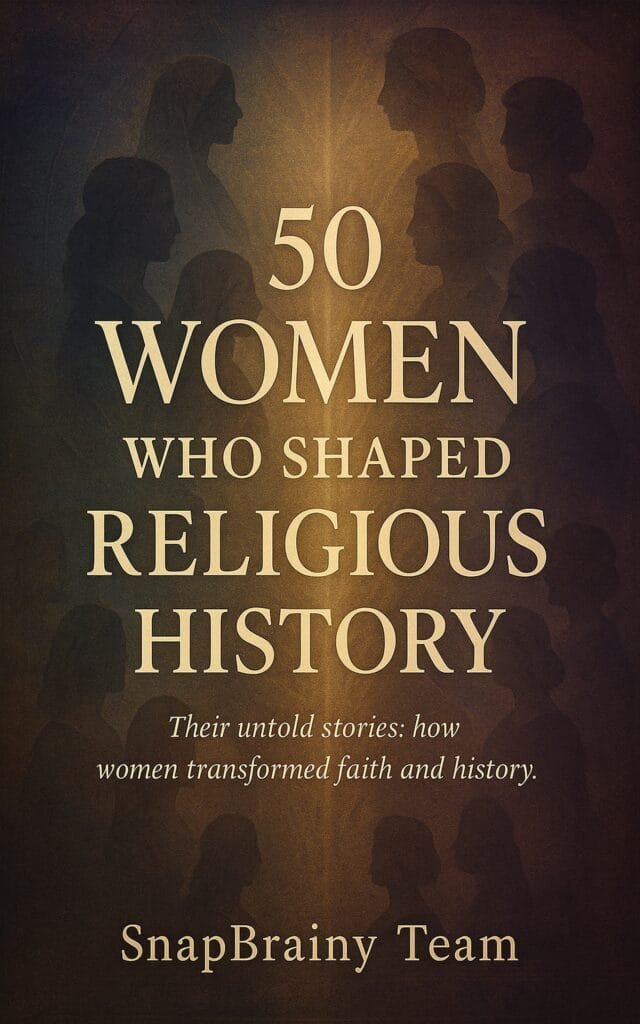
Sample chapters
What they actually did — not what tradition decided they should have done.
Abbess, composer, healer, visionary. Her theological writings were read by popes. Her music is still performed. She called herself a feather on the breath of God — then spent sixty years proving she was something more. One of the most documented women in medieval Europe.
She reformed the Carmelite order, founded seventeen convents, and wrote the most important treatise on Christian mystical prayer in existence. The Interior Castle maps the soul's journey to God with the precision of an architect. She was the first woman declared a Doctor of the Church.
The first Muslim. Before the Quran, before the community, before any of it — there was Khadijah. A successful merchant who employed Muhammad, proposed marriage to him, and was the first person he told of the revelation. She believed him when no one else did.
Born into slavery, freed herself, became a Methodist preacher, and delivered the most quoted speech in American feminist theology. Her question — Ain't I a Woman? — was not rhetorical. It was a theological argument about who counts as fully human in the eyes of God.
Mathematician, philosopher, and head of the Platonist school in Alexandria. She taught pagan philosophy in a Christian empire. When Christian mobs murdered her, they pulled down more than a woman — they ended the last great center of classical learning in the ancient world.
The poet-saint of Rajasthan who abandoned caste, widowhood restrictions, and royal life to wander singing devotional bhajans to Krishna. Her songs — still sung across India — reframed the relationship between devotee and deity as something that cannot be owned by any institution.
All 50 women
From the ancient world to the twentieth century. Every tradition. Every continent. The complete record of what women built in the name of faith.
Each chapter: era, tradition, what she built, and why it lasted.
Questions
Yes. Christianity, Islam, Judaism, Hinduism, Buddhism, and several ancient traditions. The fifty women span thirty centuries and six continents. The selection was made by influence, documentation, and the originality of their theological contribution.
No. Each woman is presented on her own terms — what she believed, what she built, and what she changed. The book makes no argument for or against any tradition.
4 to 6 pages each. Substantial enough to understand the contribution. Short enough to read in a single sitting.
PDF. Works on any device. Download once, yours forever.
Almost certainly. The chapters are built around what most general readers don't know — the specific theological arguments, the institutional conflicts, the long-term influence on doctrine and practice that popular accounts leave out.
Fifty portraits of the mystics, prophets, reformers, and scholars who built the world's great faiths — and whose names history chose to forget.
One-time purchase. Yours forever.
Secure checkout · Instant email delivery · snapbrainy.com

