Jane Goodall. Rachel Carson. Wangari Maathai. Fifty women whose work changed biology, ecology, conservation, and how every human being understands the planet they live on.
Get The Guide — $9.95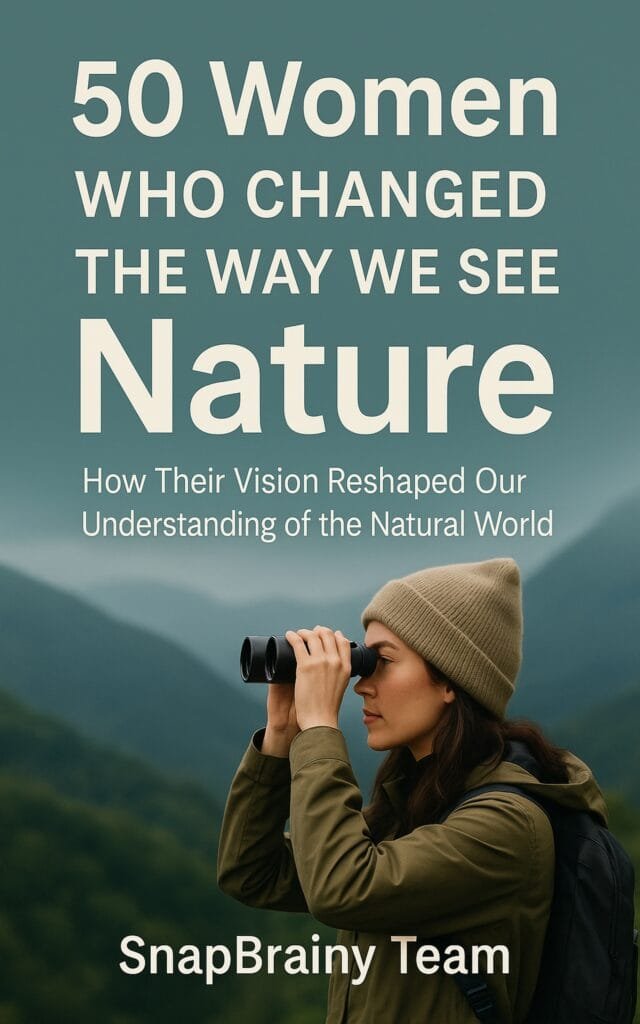
Sample chapters
What they found — and what it cost them to find it.
She arrived in Gombe in 1960 with no formal scientific training. What she found — chimps using tools, forming complex social bonds, waging war — overturned the definition of what it meant to be human. She spent sixty years proving that science done with patience and care can change how a species understands itself.
Silent Spring was published in 1962. It documented the effects of pesticides on bird populations with the precision of a scientist and the clarity of a writer. The book created the modern environmental movement, produced the EPA, and ended the commercial use of DDT. One book. One woman. That outcome.
She founded the Green Belt Movement in 1977. By the time she won the Nobel Peace Prize in 2004 — the first African woman to do so — her organization had planted more than 51 million trees across Kenya. She understood that environmental degradation and political oppression were the same problem.
She had no formal education. She sold fossils from the Jurassic coast of Dorset to survive. The specimens she found — including the first complete ichthyosaur and the first plesiosaur — transformed paleontology. The science establishment of her time credited the men who bought her fossils. History has corrected that.
She spent eighteen years living among mountain gorillas in Rwanda. When she arrived, the gorilla population was declining rapidly. Her work documented their behavior and exposed the poaching networks threatening them. She was murdered in 1985. Her research and her death both accelerated international gorilla protection.
The first female chief scientist of NOAA. More than 100 deep-sea expeditions. Twelve thousand hours underwater. Her research on ocean ecosystems established the basic framework for how marine protected areas are defined. She coined the term "blue heart of the planet" and has spent fifty years making people understand what that means.
All 50 women
Primatologists. Marine biologists. Botanists. Ecologists. Paleontologists. Fifty women who changed what we know about the world we live in.
Each chapter: field, discovery, what changed, and why it took so long to be recognized.
Questions
No. The selection spans Africa, Asia, South America, and the Pacific alongside Europe and North America. The criterion was contribution to how humans understand nature — not geography.
Mostly scientists, but also writers, conservationists, and activists. Rachel Carson, Annie Dillard, and Robin Wall Kimmerer changed how people think about nature through writing. Their contributions are as substantial as any laboratory discovery.
Yes. Several teachers have reported using chapters with secondary school students. The writing assumes general literacy but no scientific background.
PDF. Works on any device. Download once, yours forever.
4 to 6 pages. Each covers the woman's field, her specific contribution, and why it mattered — in the short and long term.
Fifty scientists, conservationists, and writers whose work transformed how we understand the planet — and whose names are not nearly well-known enough.
One-time purchase. Yours forever.
Secure checkout · Instant email delivery · snapbrainy.com

