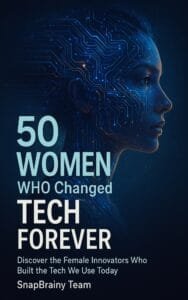
Fifty women whose work made modern computing possible — the programmers, engineers, and researchers whose names the history of technology has been slow to record.
Get The Guide — $12.99
Sample chapters
What each one built, the context they worked in, and what their work made possible.
Ada Lovelace wrote what is now recognized as the first algorithm intended for a machine to execute. She worked with Charles Babbage on his Analytical Engine and published notes in 1843 that described the machine's potential to go beyond numerical calculation. Her insight — that machines could manipulate symbols according to rules, not just crunch numbers — preceded modern computing by nearly a century. The programming language Ada, used today in aviation and military systems, is named after her.
Grace Hopper compiled the first compiler: a program that translates human-readable code into machine instructions. Before this, all programming was done in binary. She went on to develop COBOL, a programming language designed for business data processing that is still in active use in global banking infrastructure. Her insistence that programming should be accessible to people who were not mathematicians changed who could work in computing. She held the rank of Rear Admiral in the U.S. Navy and was awarded the Presidential Medal of Freedom.
Katherine Johnson calculated the orbital mechanics that made the first American human spaceflights possible. NASA called her a "human computer." Her calculations for John Glenn's 1962 Friendship 7 mission were considered so reliable that Glenn refused to fly until she personally verified the results from the electronic computer. She worked at NASA for 33 years. Her story, and the story of the other Black women mathematicians who calculated the trajectories of the Space Age, was largely untold until 2016.
Hedy Lamarr, better known as a Hollywood film star, co-invented frequency-hopping spread spectrum communication in 1942. The technology was designed to make radio-guided torpedoes harder to jam or detect. The patent expired before it was adopted militarily. The principle she developed is now the basis for Wi-Fi, Bluetooth, and GPS communication. She received the Electronic Frontier Foundation Pioneer Award in 1997 and was inducted into the National Inventors Hall of Fame in 2014.
Radia Perlman invented the Spanning Tree Protocol in 1985. STP allows network bridges to communicate without creating infinite loops — a fundamental requirement for any large-scale network to function. Without it, the architecture of the modern internet is not possible. She has been called the "mother of the internet," a title she disputes, but she holds more than 100 patents in network design. She also designed the TRILL protocol, which addresses limitations in STP she identified herself.
Margaret Hamilton led the software engineering team at MIT that developed the onboard flight software for NASA's Apollo program. Her team coined the term "software engineering" to argue that code should be treated with the same rigor as hardware. During the Apollo 11 lunar landing, her software prevented an abort by correctly prioritizing critical tasks when the computer was overloaded. Without the abort, the first moon landing could not have happened. She received the Presidential Medal of Freedom in 2016.
All 50 profiles
From Ada Lovelace to Timnit Gebru. Fifty women across two centuries of computing history.
Each chapter: the person, the contribution, the context, the lasting impact.
Questions
No. Approximately half the profiles are women who are living and working today. The book covers the full arc from the mathematical pioneers of the 19th century to current researchers in AI and cybersecurity.
No. The selection includes women from India, Japan, Israel, and other regions whose work had global impact. The criterion was contribution to computing and technology, not origin or visibility in Western media.
No. Each chapter explains what the person built, why it was significant, and what it changed — without assuming a technical background. The goal is to make the history of computing legible to any reader.
PDF. Instant download, no DRM, works on any device.
Four to six pages per person. Each covers background, contribution, the context in which it was made, and its lasting impact on technology.
Fifty women who built modern computing — from the first algorithm to the foundations of the internet, AI research, and everything in between.
One-time purchase. Yours forever.
Secure checkout · Instant email delivery · snapbrainy.com

