Fifty passive income ideas analyzed honestly — what each one pays, what it takes to set up, and how long before it becomes genuinely passive.
Get The Guide — $9.95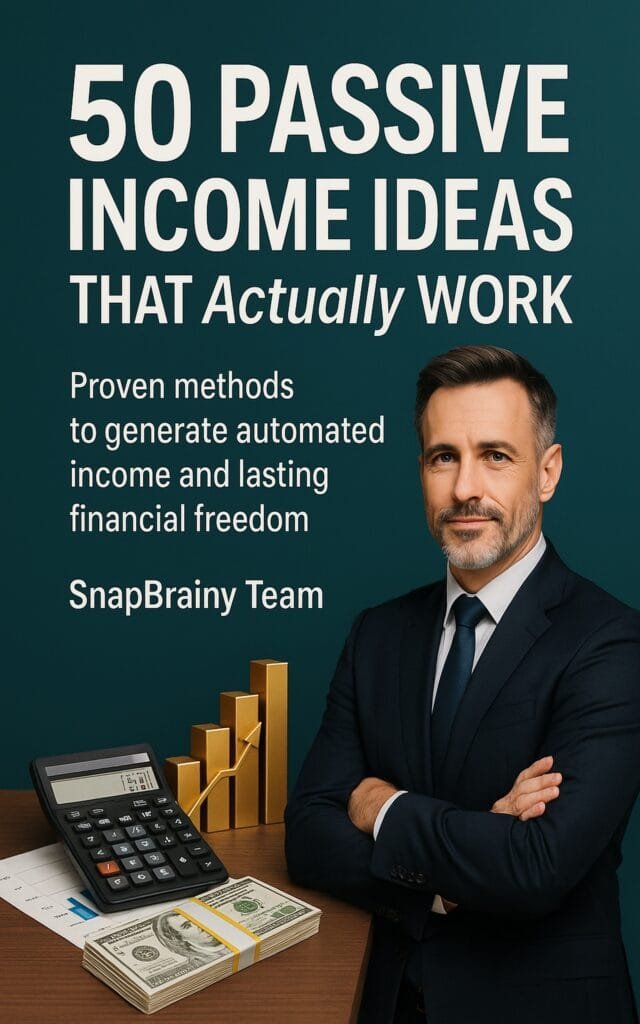
Sample chapters
What each one pays, what it costs to start, and how long before it runs without you.
A digital product — an ebook, a template pack, a course, a plugin — is created once and sold repeatedly without incremental production cost. The economics are structurally different from service work: each sale does not require a corresponding unit of your time. The constraint is distribution, not production. The chapter covers the most profitable digital product categories by market size, where to sell them, and how to build the distribution system that makes them generate income without ongoing maintenance.
Real estate rental income is passive in practice when managed through a property management company, which takes 8 to 12% of rents. The residual cash flow — after mortgage, taxes, insurance, and management — is the passive income. The chapter covers how to evaluate whether a specific property will cash flow positively, the leverage mechanics that make real estate returns asymmetric, the markets where positive cash flow is achievable in the current rate environment, and the specific mistakes that turn cash flow positive properties into liabilities.
Dividend investing — building a portfolio of stocks or funds that pay regular dividends — produces a reliable cash flow without selling shares. S&P 500 dividend yields have historically averaged around 1.5 to 2% annually. The chapter focuses on the realistic income from dividend investing at different portfolio sizes, the specific fund types (dividend ETFs, REITs, covered call ETFs) that produce higher yields, the tax treatment of different dividend types, and the long-term compounding effect of reinvesting dividends before switching to income mode.
Photographs, music, fonts, vector graphics, and software are all licensable assets. Each time someone licenses your asset for commercial use, you receive a royalty without additional work. The chapter covers the most profitable content categories on stock platforms, the submission standards required to generate consistent income, and the realistic income ranges at different portfolio sizes. Stock photography and music licensing are not get-rich strategies. They are long-tail income strategies — the income grows with portfolio size and takes 12 to 24 months to become meaningful.
Affiliate marketing generates a commission every time someone purchases a product through your referral link. The passive element is the content — a blog post, a YouTube video, a newsletter — that continues to drive traffic and conversions after creation. The chapter covers the specific niches with the highest affiliate commission rates, the types of content that generate the most conversions, the traffic acquisition strategies that do not require paid advertising, and the realistic timeline — typically 12 to 18 months — before affiliate income becomes meaningful.
Software as a service (SaaS) products generate recurring monthly revenue from subscriptions. The passive income potential is highest once the product is built and the customer acquisition system is running. The build cost is the upfront investment: development time (or contractor cost) and the initial marketing to reach the first 50 customers. The chapter covers the no-code and low-code tools that allow non-developers to build simple SaaS products, the niches with the lowest competition and highest willingness to pay, and the customer acquisition channels that work at small scale.
All 50 ideas
From digital products to real estate. Fifty income streams — each one with the math, the timeline, and the starting steps.
Each chapter: the idea, the realistic income, the startup cost, and the steps to begin.
Questions
The degree of passivity varies and the book is honest about this. Some ideas — dividend investing, licensing existing assets — are genuinely passive once set up. Others — affiliate marketing, a newsletter — require ongoing content creation. Each chapter specifies the ongoing time commitment and at what point the income becomes independent of active work.
Digital products, affiliate marketing, licensing creative work, and print on demand require minimal upfront capital — primarily time. The chapter notes startup cost for every idea so you can filter based on your situation.
Most of them are. The highest-potential ideas in this book are specifically chosen because they can be built in small blocks of time alongside existing employment. The chapter specifies the realistic time commitment per week during the build phase for each idea.
PDF. Instant download, any device, no expiry.
Four to six pages per idea. Each covers how it works, the realistic income range, the startup cost, the ongoing time commitment, and the specific steps to start.
Fifty income streams with honest numbers — what each pays, what it costs to start, and the timeline to genuine passivity.
One-time purchase. Yours forever.
Secure checkout · Instant email delivery · snapbrainy.com