Fifty historical myths that educated people repeat as fact — examined for where they came from, why they persist, and what the evidence actually shows.
Get The Guide — $9.99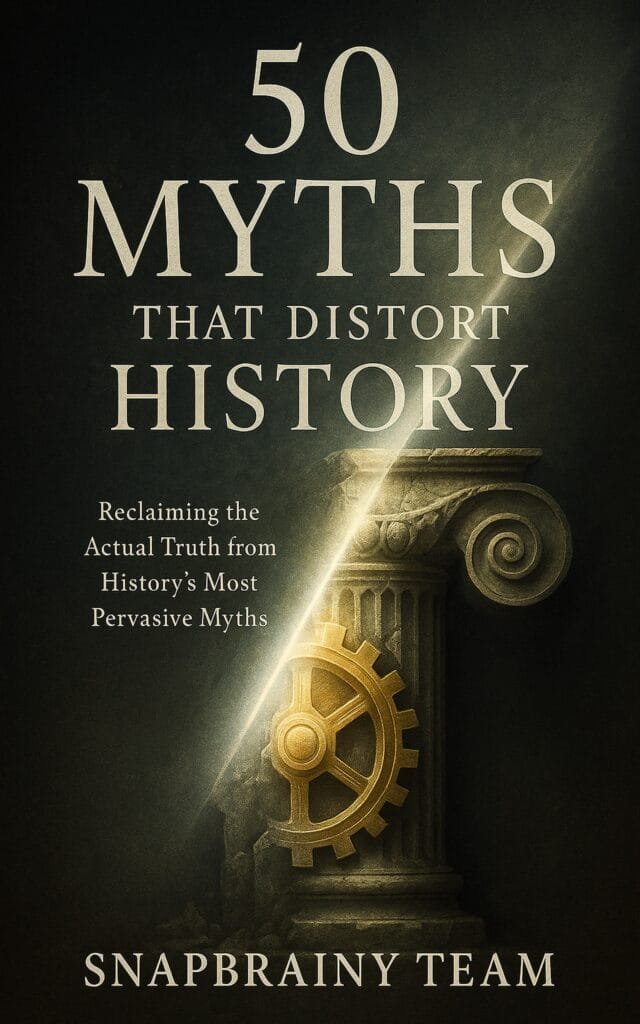
Sample chapters
What the evidence shows — and why the wrong version is more famous than the true one.
Every educated person in 1492 knew the Earth was spherical. Greek philosophers had established this two thousand years earlier. Eratosthenes had calculated the circumference within a few percent. What Columbus got wrong was the size. He believed Asia was much closer than it was. His crew was worried because the voyage was taking too long — they were right to worry. Columbus had miscalculated, not the skeptics.
Napoleon stood around 5 feet 7 inches — average height for a French man of his era. The confusion arose from a unit discrepancy: French inches were longer than British inches, and British propaganda exaggerated the difference. His nickname "le petit caporal" referred to his familiarity with ordinary soldiers, not his stature. The caricaturist James Gillray drew him small and the image stuck.
There is no reliable historical evidence that Marie Antoinette ever said this. The phrase appears in Rousseau's Confessions, written when Marie Antoinette was nine years old, attributed to an unnamed princess. The association with her appears to have developed after her death. Her letters suggest she was more aware of poverty than the myth implies.
The Great Wall is roughly as wide as a highway. From low Earth orbit, roads are not visible to the naked eye. Astronauts have confirmed this. The claim appears to have originated in a 1932 Ripley's Believe It or Not entry, before anyone had been to space. Chinese astronaut Yang Liwei confirmed in 2003 that he could not see it.
Not a single horned Viking helmet has been found in any archaeological context associated with Norse warriors. One horned helmet exists from Scandinavia — it is a Bronze Age ceremonial object from around 900 BCE, predating the Viking Age by a thousand years. The horned helmet image was popularized by nineteenth-century romantic painters and opera costume designers.
The period commonly called the Dark Ages (roughly 500–1000 CE) saw the Islamic Golden Age, which preserved and advanced Greek science; the expansion of Buddhism across Asia; sophisticated metalwork and art in Ireland and Scandinavia; and the rise of the Carolingian Renaissance. The "darkness" refers specifically to the decline of Roman urban life in Western Europe. Everywhere else, things continued.
All 50 myths
From ancient Rome to the twentieth century. Fifty things people believe that are not true.
Each chapter: the myth, the origin, the evidence, and what it costs to believe the wrong version.
Questions
No. Each chapter explains what the historical evidence actually shows, where the myth originated, why it spread, and what it displaced. Understanding why a myth persists is as important as knowing it is wrong.
The selection spans ancient history through the twentieth century. The criterion was myths that actively distort understanding of important historical events or figures — not obscure errors, but widely repeated ones that affect how people interpret history.
Each chapter reflects current historical consensus. Where historians disagree, the book presents the disagreement rather than a false certainty. Several myths are not simply false but simplified — the chapter explains what the simplification misses.
PDF. Compatible with any device. Download once, yours permanently.
Four to six pages. Each covers the myth, the historical evidence, the origin of the misconception, and why it matters that people believe something false.
Fifty widely repeated historical myths — examined for where they came from, why they persist, and what the actual evidence shows instead.
One-time purchase. Yours forever.
Secure checkout · Instant email delivery · snapbrainy.com

