Fifty historical mysteries that have baffled researchers for decades — examined for what is known, what remains unknown, and why some questions refuse to close.
Get The Guide — $11.99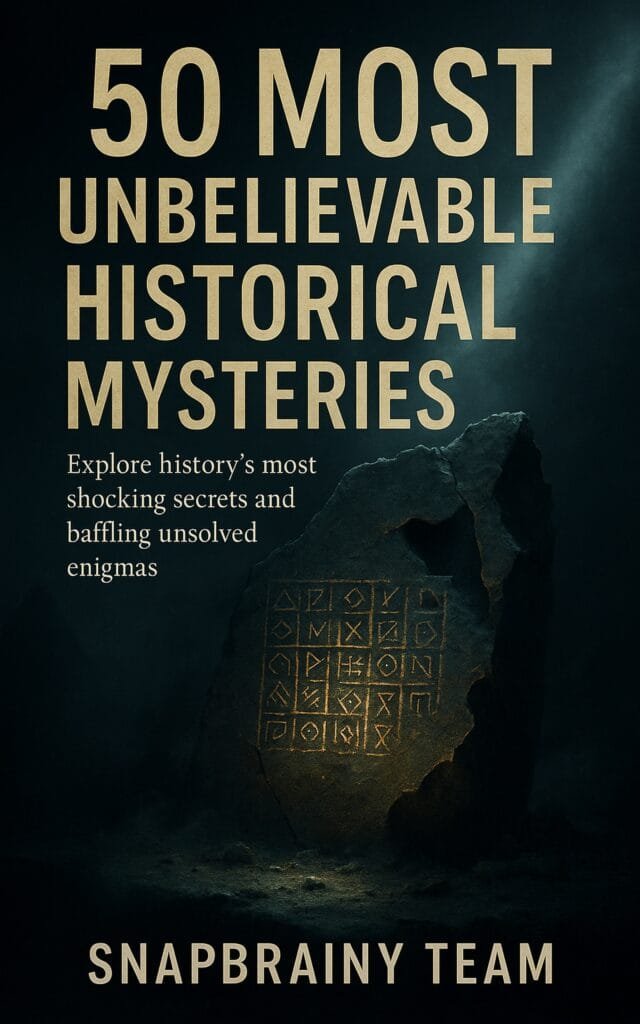
Sample chapters
What we know, what the evidence shows, and what remains stubbornly unresolved.
A 240-page illustrated book written in an unknown script that no cryptographer, linguist, or code-breaker has deciphered since its discovery. Carbon-dating places its vellum to the early fifteenth century. The illustrations show unidentifiable plants, astrological diagrams, and naked women in pools of green liquid. It may be a hoax. It may be a medical text. No one knows.
When British forces looted the royal palace of Benin in 1897, they found hundreds of bronze heads and plaques of extraordinary technical sophistication. Europeans initially refused to believe West Africans had made them. The techniques involved — lost-wax casting, precision alloy work — were more advanced than contemporary European bronze-working. The workshop tradition dated to the thirteenth century. The question of who taught whom remains unresolved.
A temple complex built 11,600 years ago — 7,000 years before Stonehenge, 6,500 years before the pyramids. The stones weigh up to 20 tons. The carvings are precise and symbolic. The builders had no writing, no wheels, no metal tools. We do not know what religion it served. We do not know who organized the labor. In 2014, excavations revealed only about 5% of the site had been uncovered.
A bronze clockwork device recovered from a Roman shipwreck, built around 100 BCE. It computed the positions of the sun and moon, predicted eclipses, and tracked the four-year Olympiad cycle. Nothing of comparable mechanical complexity appeared again for 1,400 years. The civilization that built it collapsed. The knowledge died with it. The mechanism is the only known survivor of an entire tradition of scientific instrumentation.
At 7:17 AM on June 30, 1908, an explosion equivalent to 10–15 megatons of TNT flattened 2,000 square kilometers of Siberian forest. Windows shattered 400 kilometers away. The pressure wave circled the Earth twice. No crater was found. No meteorite fragment was recovered. The area was so remote that the first scientific expedition did not arrive until 1927. The cause remains debated.
In 1587, 115 English settlers established a colony on Roanoke Island. When the supply ship returned three years later, the colony had vanished. The only clue was the word CROATOAN carved into a fence post. No bodies were found. No evidence of violence. The colonists — men, women, children, and the first English child born in America — had simply ceased to exist. No confirmed trace of them has ever been found.
All 50 mysteries
From ancient inscriptions to modern disappearances. Fifty questions history has not answered.
Each chapter: the evidence, the theories, and what remains open.
Questions
Yes, where credible explanations exist. Each chapter presents the current state of scholarly debate — confirmed facts, leading hypotheses, and what remains unknown. Where no explanation has been established, the book says so plainly rather than inventing one.
The selection spans from prehistoric archaeology (Göbekli Tepe, 9600 BCE) to the modern era (the Cicada 3301 puzzle, 2012). The criterion was genuine unresolved mystery with documented historical record, not popular legend or folklore.
Yes. Each chapter opens with enough context to understand why the mystery matters before describing what is and is not known. No prior knowledge is assumed.
PDF. Compatible with every device, no expiry. Download once, keep permanently.
Four to six pages per mystery. Each covers the discovery or event, the evidence, the leading theories, and the current state of the question.
Fifty questions that have stumped historians, scientists, and investigators for decades — examined for what the evidence actually shows and what remains genuinely unknown.
One-time purchase. Yours forever.
Secure checkout · Instant email delivery · snapbrainy.com

