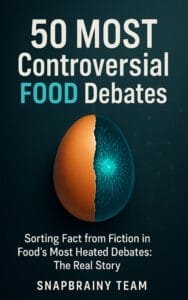
Fifty food controversies — from red meat to lab-grown protein — examined with both sides of the argument and the evidence behind each position.
Get The Guide — $12.99
Sample chapters
Each one: the evidence on both sides, who funds the research, and where the science actually stands.
On one side: dozens of epidemiological studies linking red meat consumption to colorectal cancer, cardiovascular disease, and all-cause mortality. On the other: critics pointing out that these studies cannot separate red meat from processed meat, that they rely on food frequency questionnaires notorious for inaccuracy, and that hunter-gatherer populations eating high-meat diets show none of the predicted disease profiles. The research is real. So are the methodological objections.
Butter was demonized for saturated fat. Margarine, made with hydrogenated vegetable oils, was prescribed as the healthy alternative — until trans fats were linked to cardiovascular disease more strongly than saturated fat. Margarine was reformulated. Olive oil's Mediterranean association produced its own mythology. Each camp has funding from industries invested in the outcome. What the research consistently shows: ultra-processed fat substitutes perform worse than traditional fats. Beyond that, the debate continues.
Proponents cite research showing plant-based diets associated with lower rates of cardiovascular disease, type 2 diabetes, and certain cancers. Critics note that B12 deficiency, iron deficiency, and omega-3 gaps require supplementation not needed in omnivorous diets, and that some populations — athletes, growing children, pregnant women — face particular risks. The evidence supports that a well-planned vegan diet can be nutritionally complete. "Well-planned" is doing significant work in that sentence.
Soy contains phytoestrogens — plant compounds that bind to estrogen receptors. Some studies suggest benefits for menopausal women. Others suggest endocrine disruption risks, particularly in men. The research is genuinely mixed, and the studies are funded by competing interests: the soy industry on one side, the dairy industry on the other. Current scientific consensus holds that moderate soy consumption is safe for most adults. The "moderate" qualifier is where the debate lives.
This is not a nutritional debate — it is an ethical one. The utilitarian case against meat consumption is that the suffering produced outweighs the benefit, given that plant-based nutrition is available. The counter-case involves cultural sovereignty, the ecological role of traditional pastoralism, and the question of whether plants deserve moral consideration. The scientific question of whether meat is necessary is largely settled: it is not. The moral question of whether humans should eat it is not, and may never be.
For people with celiac disease — roughly 1% of the population — gluten triggers an autoimmune response causing serious intestinal damage. For people with non-celiac gluten sensitivity — a diagnosed condition affecting perhaps 6% — gluten produces symptoms without autoimmune response. For the 93% of the population that is neither: the evidence for harm is absent. The gluten-free market is worth $7 billion. Most of the people buying gluten-free products have no medical reason to.
All 50 debates
From dietary fat to lab-grown meat. Fifty food controversies examined with the evidence on both sides.
Each chapter: the science, the funding, the evidence on both sides, and where the debate stands today.
Questions
Where the scientific evidence clearly favors one position, the chapter says so. Where the evidence is genuinely mixed, or where the debate involves values rather than facts, the chapter presents both sides accurately. The goal is to give readers the tools to form their own informed position, not to tell them what to think.
Both types are covered. Some debates are scientifically contested with competing bodies of legitimate research. Others are media controversies where the scientific consensus is clearer than the public debate suggests. The chapter explains which category each debate falls into.
Yes. Each chapter explains the relevant science before describing the debate. Technical terms are defined where they appear. No prior nutrition knowledge is assumed.
PDF. Compatible with every device without expiry. Download once, keep permanently.
Four to five pages per debate. Each covers the scientific evidence on both sides, the funding landscape where relevant, and the current state of the argument.
Fifty food controversies examined with both sides of the argument — the science, the funding, and where the evidence actually stands.
One-time purchase. Yours forever.
Secure checkout · Instant email delivery · snapbrainy.com

