Confirmation bias. Catastrophizing. All-or-nothing thinking. Fifty mental traps mapped precisely — how they work, why they are hard to see, and how to escape each one.
Get The Guide — $12.99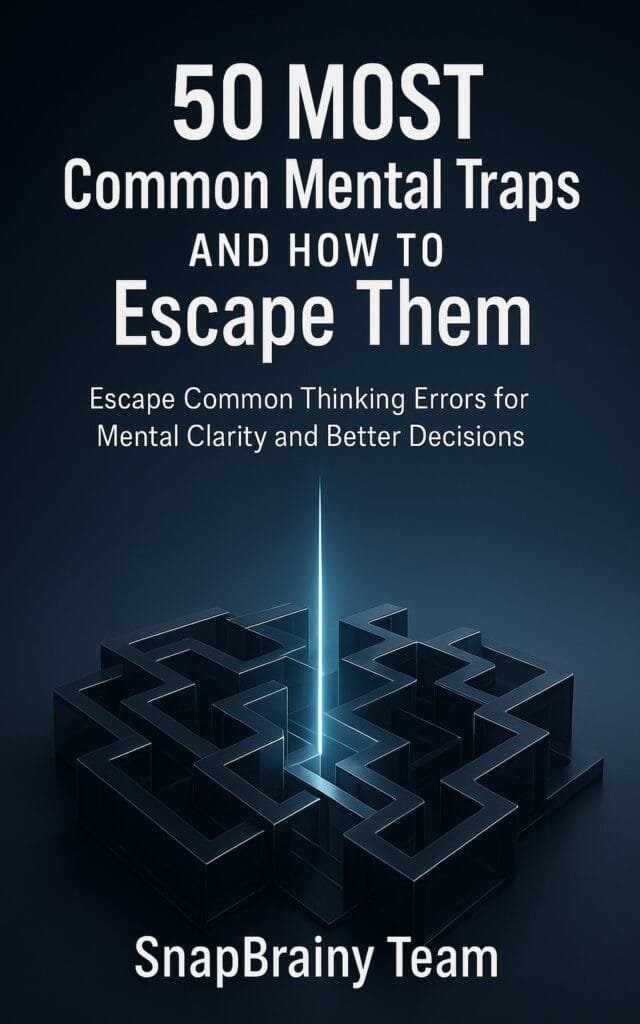
Sample chapters
Understanding the mechanism is the first step. Most people skip it and go straight to advice. That's why the advice doesn't stick.
You search for information that confirms what you already believe. You ignore or dismiss what challenges it. The trap closes tighter the more intelligent you are — because you are better at building arguments for the wrong conclusion. The chapter maps how to deliberately seek disconfirmation.
You feel something, so you treat it as evidence. You feel anxious, so the situation must be dangerous. You feel guilty, so you must have done something wrong. Feelings are data about your internal state. They are not evidence about external reality. The distinction matters.
You are comparing your insides to other people's outsides. Their highlight reel to your raw footage. The trap produces chronic dissatisfaction from accurate perception of an inaccurate sample. The chapter covers why comparison is unavoidable and how to choose the comparisons that are actually useful.
You see outcomes as total success or total failure. There is no partial credit. Because perfection is rare and failure is common, this trap produces chronic undervaluation of real progress. The chapter explains why the binary feels natural and how to replace it with a workable gradient.
You treat your abilities as fixed quantities rather than developable capacities. This makes failure evidence of permanent limitation rather than information about the current state of a skill. Dweck's research is well known. What's less discussed is how to move the dial in practice.
You move from a bad outcome to the worst possible outcome in one step. Missing a deadline becomes career failure. A difficult conversation becomes relationship collapse. The chapter maps the typical catastrophizing sequence and the specific interruption points where the spiral can be stopped.
All 50 traps
Cognitive. Emotional. Social. Identity. Every mental trap — and the way out of each one.
Each chapter: the trap, how it closes, why it is hard to see, and the specific escape routes.

Questions
Neither. It is a map. Each chapter explains how a specific mental trap works — the mechanism, why it is self-reinforcing, and what disrupts it. What you do with that understanding is yours to decide.
Many readers do. Several therapists have said they recommend it to clients as a companion to sessions. It builds the conceptual vocabulary that makes therapeutic work more efficient.
Both. Each chapter stands alone. But several traps compound each other — the book notes where this happens. Catastrophizing and all-or-nothing thinking, for instance, share a mechanism. The connections are mapped where they are useful.
PDF. Works on any device. Download once, yours forever.
4 to 5 pages. Enough to understand the trap clearly. Short enough to read in a single sitting.
The thinking errors that hold most people back — mapped precisely, with the mechanism and the specific way out of each one.
One-time purchase. Yours forever.
Secure checkout · Instant email delivery · snapbrainy.com

