Fifty financial beliefs that are factually wrong — the myths that lead to bad decisions, and what the evidence actually shows.
Get The Guide — $9.99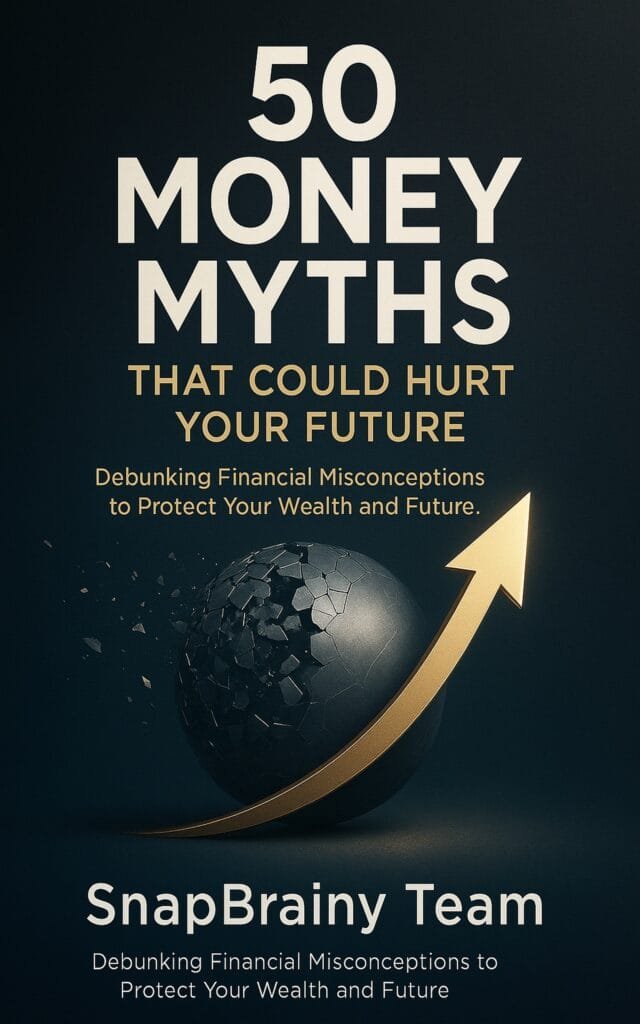
Sample chapters
Beliefs that feel like common sense and quietly destroy financial outcomes over time.
Homeownership builds equity. Renting does not. This is true. It is not the full picture. Homeowners pay mortgage interest, property taxes, insurance, maintenance, and transaction costs on entry and exit. In many markets, buying and selling within five years produces a worse financial outcome than renting and investing the equivalent capital. The decision depends on the price-to-rent ratio in the specific market, the holding period, and what would happen to the freed-up capital. The chapter covers the actual math for each scenario.
Income and savings rate are separate variables. Research on household savings consistently shows that savings rates do not automatically rise with income — lifestyle inflation typically absorbs the increase instead. The mechanism is behavioral, not mathematical: if saving requires a decision each month, most months it will not happen. Automatic transfers, set as a fixed percentage of income on the day it arrives, are the intervention that changes this pattern. The amount is less important than the system.
The SPIVA Scorecard, published twice yearly by S&P, shows that the majority of actively managed funds underperform their benchmark index over every 5-, 10-, and 15-year horizon. Individual investors, without the resources of professional analysts, perform worse than funds on average. The reason is not stupidity. It is the efficient market: prices reflect available information. An index fund holds the market; an individual stock picker bets against the collective judgment of all other market participants. Over long periods, this bet rarely wins.
This is one of the most financially damaging myths in personal finance. Credit scores are built from payment history, utilization ratio, age of accounts, credit mix, and new inquiries. Payment history is the dominant factor. Carrying a balance and paying interest does not improve a credit score. Paying in full every month, on time, produces the maximum positive effect on payment history and keeps utilization low. The myth persists because it benefits credit card issuers, not cardholders.
Cash in a savings account is safe from market volatility. It is not safe from inflation. At 3% annual inflation, purchasing power falls by roughly 26% over ten years. A savings account paying 0.5% does not offset this loss. For short-term goals and emergency funds, savings accounts are correct. For long-term wealth accumulation, they guarantee a slow loss in real terms. The chapter covers the correct allocation of cash versus invested assets based on time horizon.
A mortgage at 3.5% costs 3.5% to carry. A diversified index fund portfolio has returned an average of 7–10% annually over long periods. Mathematically, the better financial outcome is to maintain the low-interest mortgage and invest the surplus. The psychological case for paying off the mortgage early — reduced risk, guaranteed return equal to the interest rate, peace of mind — is real and sometimes correct. The chapter explains how to make this decision based on interest rate, tax situation, and risk tolerance.
All 50 myths
From renting myths to investing myths. Fifty beliefs — and what the evidence actually shows for each one.
Each chapter: the myth, the evidence, the cost of believing it, and the correct view.
Questions
The core myths are universal. Where specifics vary — account types, tax rules, local real estate dynamics — the chapter notes the variation. The principles around inflation, compound growth, debt cost, and investor behavior apply globally.
Yes. The mistakes book covers behavioral errors and omissions — things people fail to do. This book covers beliefs that are factually wrong — things people actively believe that cause them to make poor decisions. The two books are complementary but non-overlapping.
No. The book explains what the evidence says about investment categories and strategies. It does not recommend specific products, funds, or assets. The goal is to give readers the framework to evaluate their own decisions.
PDF. Instant download, any device, no expiry.
Three to five pages per myth. Each covers the belief, the evidence against it, the cost of believing it, and the correct understanding.
Fifty financial beliefs that lead to bad decisions — and what the evidence shows for each one.
One-time purchase. Yours forever.
Secure checkout · Instant email delivery · snapbrainy.com