Fifty widely believed myths about how the brain learns — debunked by cognitive research and replaced with strategies that actually work.
Get The Guide — $9.99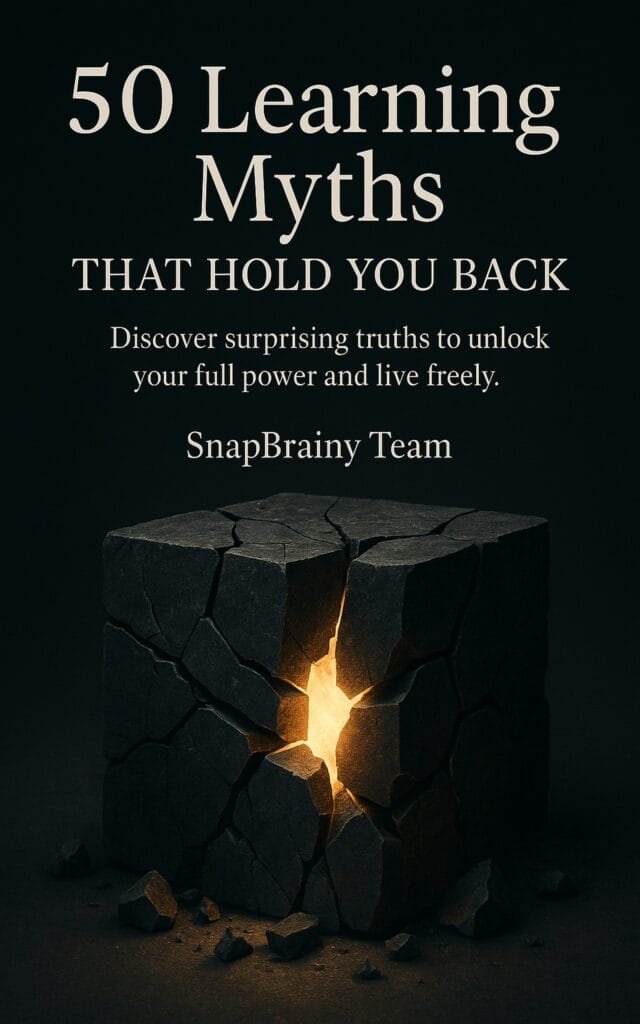
Sample chapters
What the research actually shows — and what to do instead.
The learning styles theory — that people are visual, auditory, or kinesthetic learners and should be taught accordingly — has no support in controlled research. Dozens of studies have attempted to find a benefit for matching instruction to alleged learning style and found none. The theory persists because it is intuitively appealing, not because it works. Teaching methods that mix presentation types consistently outperform style-matched approaches.
This claim is false in every testable sense. Brain imaging shows that all areas of the brain have measurable function. Damage to any part of the brain produces measurable deficits. The myth may have originated in a misquote of William James, or a misreading of early neuroscience. It has no scientific basis and has never had one. Every part of your brain is active at some point during every day.
The 10,000-hour rule comes from a study of violinists by Anders Ericsson, popularized by Malcolm Gladwell in Outliers. Ericsson later clarified that Gladwell misrepresented the research. The study found that the top violinists had accumulated about 10,000 hours of deliberate practice by age 20 — not that 10,000 hours guarantees expertise. The type of practice matters more than the quantity. Mindless repetition does not produce mastery.
The forgetting curve, first documented by Hermann Ebbinghaus in 1885, shows that humans forget approximately 50% of new information within an hour of learning it, and 70% within a day. Reading something once without active retrieval produces almost no long-term retention. Spaced repetition — reviewing material at increasing intervals — produces dramatically higher retention and is one of the most reliable findings in educational psychology.
Two of the most common study methods — highlighting text and rereading it — are among the least effective strategies tested by cognitive scientists. Both feel productive because they involve low cognitive effort while producing an illusion of fluency: the material feels familiar, which is confused with understanding. Retrieval practice (testing yourself without the material visible) and spaced repetition consistently produce better long-term retention.
Research on expertise consistently shows that performance is the product of deliberate practice, not innate talent alone. The Dunning-Kruger effect shows that people with low competence tend to overestimate it, while people with high competence often underestimate it — because they understand how much there is to know. The belief that talent is fixed reduces motivation and persistence. The evidence shows that effort is the primary driver of skill development across almost every domain studied.
All 50 myths
From learning styles to the 10,000-hour rule. Fifty things people believe about learning that the science does not support.
Each chapter: the myth, the evidence, and the research-backed alternative.
Questions
Both. The myths covered affect learning at every stage of life. Students will find it directly applicable to study habits. Professionals will find it useful for training design, team development, and understanding their own skill acquisition. Parents will find it useful for how they support children's education.
Yes. Each chapter covers the myth, the evidence against it, and the research-backed alternative. The book does not just debunk — it replaces each myth with a practical strategy that the evidence supports.
Practical guidance. Each chapter closes with a concrete application: what to do differently, starting today, based on what the research shows. The science is included to explain why — not to replace the instruction.
PDF. Works on any device without expiry. Download once, keep permanently.
Three to five pages per myth. Each covers the myth, the evidence, the origin of the misconception, and the research-backed alternative.
Fifty beliefs about learning that cognitive science has overturned — and the research-backed strategies that replace them.
One-time purchase. Yours forever.
Secure checkout · Instant email delivery · snapbrainy.com

