Fifty civilizations that rose, flourished, and vanished — examined for what they built, what they achieved, and why they disappeared from the history we are taught.
Get The Guide — $12.99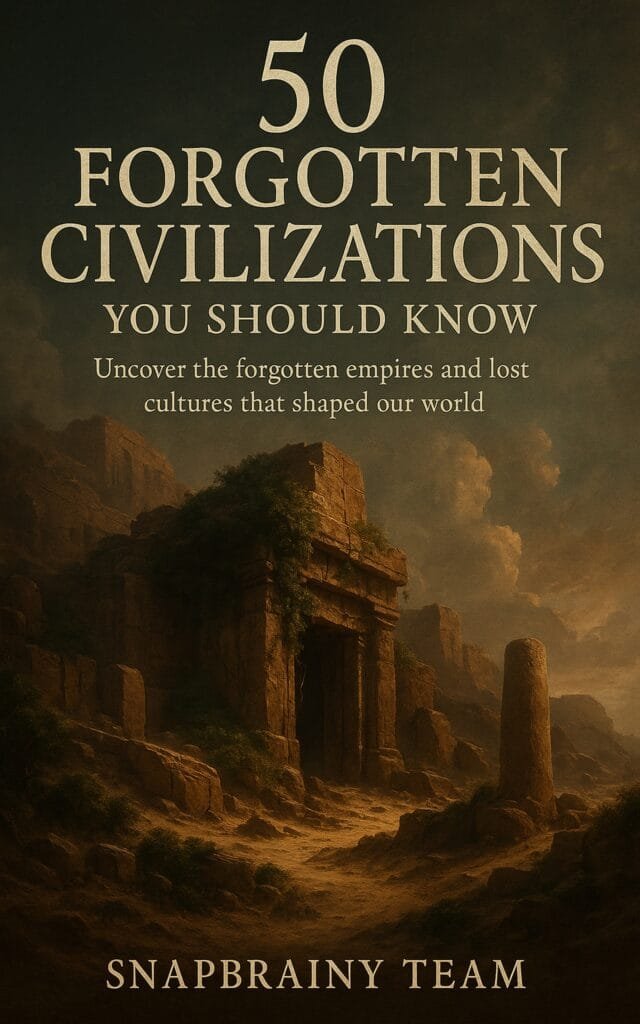
Sample chapters
What they built, what they achieved, and what erased them from the story we were taught.
At its height, the Indus Valley Civilization covered more land than ancient Egypt and Mesopotamia combined. Its cities had standardized bricks, indoor plumbing, and street grids that would not reappear in Europe for three thousand years. Their writing system has never been deciphered. We do not know their language, their religion, or why they disappeared.
The Chacoans built great houses — stone structures four stories tall — across hundreds of kilometers of desert, connected by roads so straight they appear to have been engineered by people with aerial perspective. They aligned their buildings to solar and lunar cycles with precision that astonishes modern astronomers. Then, in the twelfth century, they were gone.
Funan was the first major state of mainland Southeast Asia, dominating trade routes between India and China for six centuries. Roman coins have been found at its ports. Its art blended Indian and local traditions in ways that shaped every subsequent culture in the region. Funan collapsed, was absorbed, and largely disappeared from Western historical accounts.
At 3,800 meters above sea level — higher than any major European capital — Tiwanaku built a city of 20,000 people and an agricultural system that transformed the Andes. Their raised-field technique created microclimates that protected crops from frost. Modern Bolivian farmers have revived the technique and dramatically increased their yields. The original engineers have been forgotten.
The stone enclosures of Great Zimbabwe are the largest pre-colonial structures in sub-Saharan Africa. Built without mortar, the walls stand eleven meters high. Great Zimbabwe was a trading hub linking the African interior to Arab, Indian, and Chinese merchants. When European archaeologists arrived in the nineteenth century, some refused to believe Africans had built it.
The Minoans were the first advanced civilization in Europe. Their art shows women in positions of authority, acrobats leaping over bulls, and a world with no visible fortifications — suggesting a society confident enough not to build walls. Their palace at Knossos had flush toilets. Their writing, Linear A, has never been decoded.
All 50 civilizations
From the Indus Valley to the Etruscan plains. Fifty worlds that existed before history forgot them.
Each chapter: geography, significance, and the story of how they were forgotten.
Questions
A civilization qualifies as "forgotten" if it is absent from most secondary school curricula and unknown to most educated adults in the English-speaking world — regardless of its historical significance. Several civilizations in this book were larger, more sophisticated, or more influential than civilizations that are widely taught.
The majority are non-Western, because non-Western civilizations are underrepresented in standard curricula. However, the selection includes several European civilizations — the Minoans, the Etruscans, the Lydians — that are routinely omitted from popular history.
Each chapter reflects current archaeological and historical consensus where consensus exists. Where scholarly debate continues — for example, regarding the Indus Valley script or the causes of Minoan decline — the debate is described rather than resolved.
PDF. Works on any device without expiry. Download once, keep permanently.
Four to six pages per civilization. Each covers geography, period, what made it significant, why it was forgotten, and what remains.
Fifty civilizations that rose, flourished, and vanished — examined for what they built, what they achieved, and why the history we are taught left them out.
One-time purchase. Yours forever.
Secure checkout · Instant email delivery · snapbrainy.com

