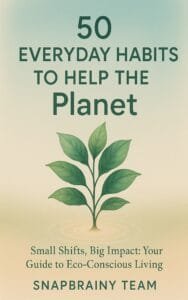
No guilt. No preaching. Fifty everyday habits with the actual impact data — so you can choose the ones worth doing and skip the ones that aren't.
Get The Guide — $12.99
Sample chapters
Most environmental advice tells you what to do. This tells you what it actually changes.
Replacing one day of meat per week with plant-based food reduces an individual's annual carbon footprint by roughly 340 kg of CO2 equivalent. That is comparable to not driving a car for six weeks. The chapter explains which proteins have the largest footprint, which have the smallest, and what the substitution math looks like.
90 percent of the energy used by a washing machine goes to heating the water. Switching to cold water saves roughly $60 per year and avoids 230 kg of CO2 annually. Modern detergents are formulated for cold temperatures. The performance difference in most household laundry is zero.
Fast fashion accounts for 10 percent of global carbon emissions. The 30-wear rule asks one question before buying clothing: will you wear this item at least 30 times? The chapter explains the lifecycle emissions of different fabrics, and why second-hand extends utility without new manufacturing.
A single return flight from London to New York produces more CO2 than six months of driving. The chapter covers the carbon hierarchy of travel options and the specific alternatives that most people have not considered, including train routes that cover comparable distances in comparable time.
Electronics in standby mode account for 5 to 10 percent of household electricity use. A typical household has 40 devices drawing power continuously. The chapter maps which devices draw the most phantom load, which are safe to unplug, and what the annual savings look like per device.
Roughly one-third of all food produced globally is wasted. In households, the main culprits are vegetables, fruit, and bread. The chapter covers planning strategies, storage practices, and the specific interventions that reduce household waste by 40 to 60 percent without dietary change.
All 50 habits
Food. Energy. Travel. Shopping. Home. Fifty habits covering every area of daily life — from easy wins to high-leverage changes.
Each chapter: the habit, the impact data, the how-to, and what to expect.
Questions
They vary. The book is organized around impact and difficulty. Some habits require no behavior change — they require one decision and then they run automatically. Others require ongoing effort. The chapter tells you which is which.
The book addresses this directly. Individual habits matter less than systemic change — and the book says so. But the book also shows that household decisions account for a larger share of emissions than most people realize, and that some habits have disproportionately high leverage.
No. The chapters explain impact clearly, without moralizing. The goal is information that lets you make better decisions, not a performance of environmental virtue.
PDF. Works on any device. Download once, yours forever.
3 to 4 pages. Each covers what the habit is, why it matters, the actual impact numbers, and how to start.
Fifty habits with the actual impact data — so you can choose the ones that matter and skip the performance.
One-time purchase. Yours forever.
Secure checkout · Instant email delivery · snapbrainy.com

