Chernobyl. Bhopal. The Cuyahoga River. Deepwater Horizon. Fifty environmental disasters — what caused them, what they revealed, and what they changed.
Get The Guide — $9.99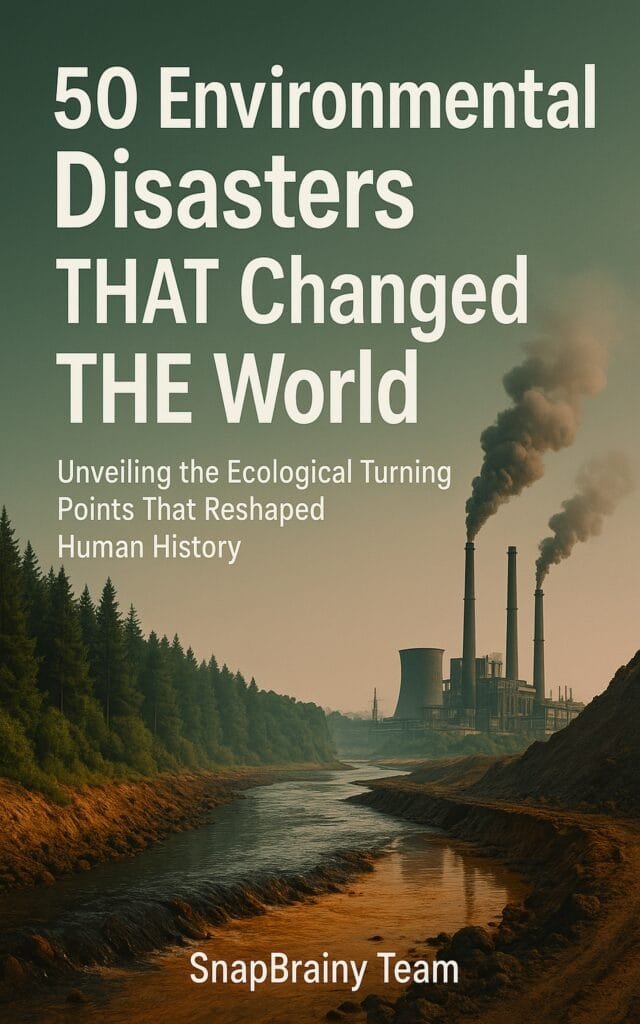
Sample chapters
Each one a moment where something broke — and what was built from the wreckage.
The worst nuclear accident in history contaminated 150,000 square kilometers. The immediate response exposed the full fragility of Soviet information control. The long-term result: a rethinking of nuclear safety standards worldwide, and an acceleration of the political conditions that ended the Soviet Union.
A gas leak at a Union Carbide pesticide plant killed at least 3,787 people overnight and injured 500,000 more. It remains the deadliest industrial accident in history. The legal aftermath — including what Union Carbide paid and what it did not — reshaped international corporate liability law.
The river caught fire. It had done so twelve times before. The 1969 fire was the one that made the front page of Time magazine. Fourteen months later, the United States passed the Clean Water Act. This is the most direct line from a single environmental event to landmark legislation in American history.
Eleven workers killed. 4.9 million barrels of oil released. The cleanup cost BP $65 billion. The chapter examines not the spill itself but what the response revealed: about the limits of deep-water drilling engineering, about corporate risk management, and about the regulatory capture that allowed the conditions to exist.
Five days in December 1952. The smog killed between 4,000 and 12,000 people. It was invisible until it was over. The chapter examines how it changed British air quality policy, what it revealed about the relationship between industrial activity and public health, and why it took four years to acknowledge the death toll.
10.8 million gallons of crude oil. 1,300 miles of coastline. The Exxon Valdez oil spill accelerated the transition to double-hulled tankers worldwide and produced the most significant shift in US maritime environmental law in a generation. The chapter examines what changed and what did not.
All 50 disasters
Industrial accidents. Oil spills. Ecological collapses. Climate events. The complete record of what went wrong — and what changed because of it.
Each chapter: the event, the response, the consequences, and what changed.
Questions
No. Each chapter explains what happened, who was involved, what decisions were made, and what changed afterward. The focus is on causes and consequences, not prosecution.
No. The book spans from the 1930s Dust Bowl to the 2019 Amazon burning. Several are historical events that produced consequences still shaping environmental law and policy today.
No. The selection is global — events in India, China, the Soviet Union, Africa, Southeast Asia, and South America alongside the United States and Europe.
PDF. Works on any device. Download once, yours forever.
4 to 6 pages. Each chapter covers the event, the immediate response, the long-term consequences, and what changed as a result.
Fifty catastrophes — what caused them, what was concealed, what was exposed, and what laws, technologies, and policies emerged from the wreckage.
One-time purchase. Yours forever.
Secure checkout · Instant email delivery · snapbrainy.com

