Not opinion. Not prediction. Fifty facts about climate change drawn directly from peer-reviewed science — what is happening, how fast, and what it means.
Get The Guide — $9.99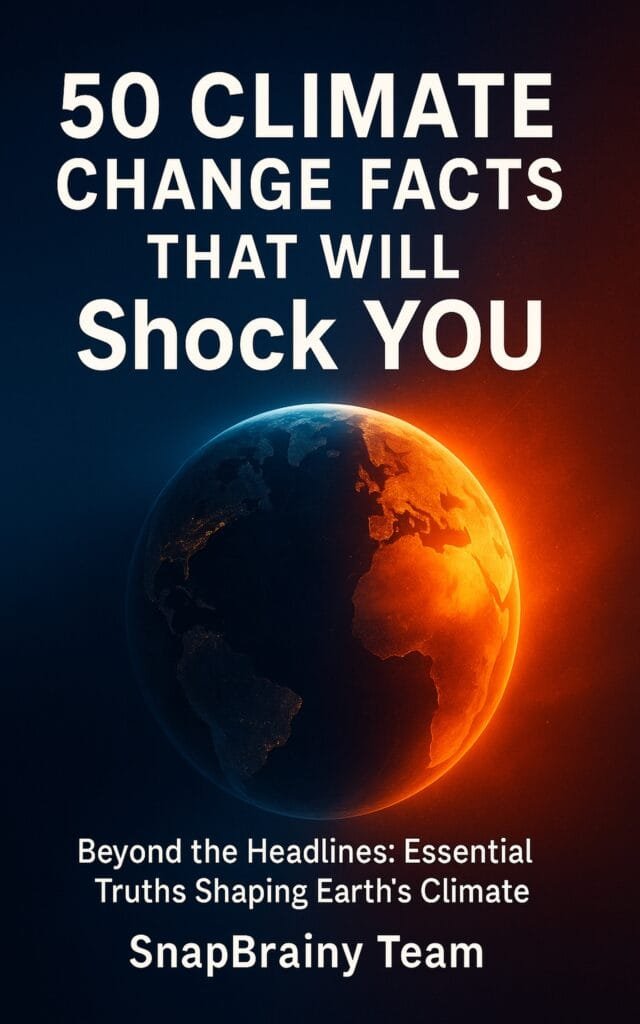
Sample chapters
The data is clear. The problem is not information. The problem is context that makes the information land.
The period 2011 to 2020 was the warmest decade since the last interglacial period. The global average temperature is now 1.2°C above pre-industrial levels. The rate of warming in the last 50 years is ten times faster than any natural warming event in the geological record.
At current rates, Greenland alone will contribute between 24 and 65 cm of sea-level rise by 2100. The ice sheet is losing mass seven times faster than in the 1990s. The process that drives this — surface melt feeding ice sheet drainage — is a feedback loop with no natural brake.
Ocean pH has dropped from 8.2 to 8.1 since 1800 — a 30% increase in acidity. The rate of change is faster than anything in the last 300 million years. Coral reefs, shellfish, and the base of the marine food chain depend on pH levels that are shifting faster than these organisms can adapt.
The frozen soil of the Arctic contains approximately 1.5 trillion tonnes of carbon — roughly double the amount currently in the atmosphere. As permafrost thaws, it releases methane and CO2. This is a self-reinforcing loop: warming releases carbon, carbon causes warming.
Events that would naturally occur once every 50 years now occur roughly every 10 years. The 2021 Pacific Northwest heat dome, which killed 1,400 people, was assessed as virtually impossible without climate change. Attribution science can now quantify how much climate change contributed to specific events.
Species are going extinct at 1,000 times the natural background rate. Climate change is the accelerant. Habitat loss is the primary driver. The two interact: a species that might survive habitat loss has a much lower chance of surviving habitat loss plus 2°C of warming. The combination is the problem.
All 50 facts
Temperature. Ice. Ocean. Species. Policy. Finance. The full scientific and political landscape of climate change in one guide.
Each chapter: the fact, the data source, the context, and the implication.
Questions
Every fact in this book is drawn from peer-reviewed science, IPCC reports, or assessments by major scientific bodies. Where figures are ranges, the chapter uses the scientific consensus range. Sources are cited at the end of each chapter.
Some chapters are sobering. The book does not hide from that. The final section covers what is actually working — the decline of clean energy costs, the pace of electrification, the science of ecosystem restoration. The picture is serious. It is not without direction.
Yes. The writing is clear and assumes no prior scientific knowledge. Several educators have reported using it with secondary school students.
PDF. Works on any device. Download once, yours forever.
3 to 4 pages. Each covers the fact, the data behind it, what it means in context, and what it implies for action.
Fifty facts from peer-reviewed science — with the context that makes them impossible to dismiss and the direction that makes them possible to act on.
One-time purchase. Yours forever.
Secure checkout · Instant email delivery · snapbrainy.com