Thermopylae. Waterloo. Midway. Stalingrad. Fifty battles that redirected the course of civilizations — examined for what actually happened and why it mattered.
Get The Guide — $12.99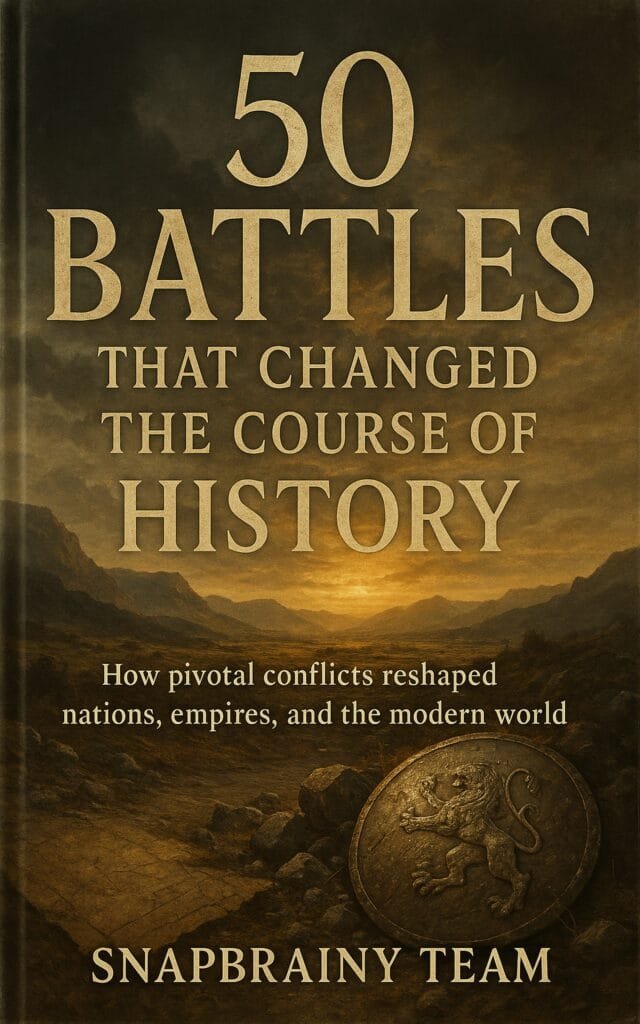
Sample chapters
What actually happened — and why each outcome was not inevitable until it was.
Three hundred Spartans held a mountain pass for three days against a Persian army of 100,000. They all died. The delay allowed Athens to evacuate and the Greek fleet to maneuver. The Battle of Salamis that followed ended the Persian invasion. Thermopylae is remembered as a defeat that saved Western civilization — which is not inaccurate.
Harold II died with an arrow through his eye. The Norman Conquest replaced the English ruling class, administrative language, and legal system in a single generation. Modern English carries the marks of that afternoon: beef, pork, and mutton are Anglo-Saxon animal names; veal, porc, and mutton are the French names for the prepared meat that conquerors ate.
Henry V led 6,000 exhausted English troops against 36,000 French knights. The English longbow turned the battle into a slaughter. The French lost over 6,000 men; the English, perhaps 400. Agincourt ended the military dominance of the armored knight and accelerated the transition to professional infantry armies.
Napoleon was defeated in eight hours by a combination of Prussian reinforcements and British defensive position. The battle ended the Napoleonic Wars, established Britain as the dominant European power for a century, and created the political settlement that shaped Europe until 1914. Wellington called it "the nearest run thing you ever saw."
The United States Navy was outgunned and outnumbered. American cryptanalysts had broken the Japanese naval code. In five minutes of dive-bombing on June 4, 1942, the Imperial Japanese Navy lost four aircraft carriers, 248 planes, and 3,057 men. Japan never recovered its offensive capability in the Pacific.
Six months of street-by-street fighting. 2 million casualties. The German Sixth Army, 300,000 men, was surrounded and destroyed. Stalingrad was the turning point of the Eastern Front and, arguably, of the entire Second World War. After Stalingrad, the Wehrmacht was never again capable of major offensive operations in the East.
All 50 battles
From ancient Greece to the War on Terror. Three thousand years of the battles that remade the world.
Each chapter: context, engagement, outcome, and consequence.
Questions
No. The selection spans ancient Persia, medieval Central Asia, East Africa, Japan, China, and the Americas alongside European and North American conflicts. The criterion was which battles produced the largest shift in the subsequent course of history.
Yes. Each chapter covers the decision-making, strategic context, and experience of both forces. The goal is understanding what happened, not celebrating any particular army.
None. Each chapter explains the strategic context before describing the battle. A reader who has never read military history will understand what is at stake in each engagement.
PDF. Works on any device. Download once, yours forever.
4 to 6 pages. Each covers the strategic context, the engagement itself, the outcome, and what changed afterward.
Three thousand years. Fifty engagements. The battles that remade empires, ended wars, and redirected the course of civilizations — examined for what actually happened and why.
One-time purchase. Yours forever.
Secure checkout · Instant email delivery · snapbrainy.com

